
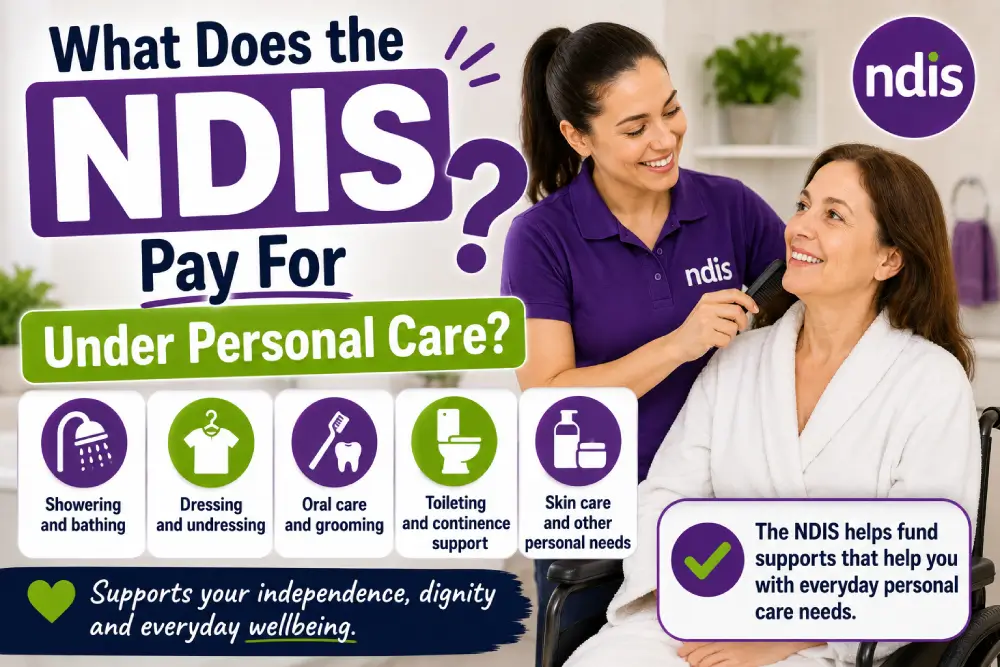
Personal care is the most fundamental NDIS support — and one of the most varied. What one participant needs from their morning routine is completely different from what another participant needs. This is what NDIS funding actually covers, and what it does not.
The Funding Category
Personal care is funded under Core Supports as ‘Assistance with Daily Life’ (sometimes called ‘self-care’). It pays for support workers to assist with the routine activities of getting through a day.
There are two tiers:
- Standard Daily Personal Activities. Routine assistance with personal care for participants without complex clinical needs.
- High Intensity Daily Personal Activities (HIDPA). Complex care requiring specific training — two-person transfers, ventilation support, PEG feeding, complex bowel care, and similar tasks.
HIDPA is funded at a higher hourly rate to reflect the additional training and skill required.
What Personal Care Covers
- Showering and bathing — supervision, physical assistance, or full assistance depending on what the participant needs. Some participants need help only with washing hair; others need full physical support.
- Dressing and grooming — selecting clothes, putting them on, fastening buttons or zips, brushing hair, shaving, applying skin care or cosmetics.
- Toileting — scheduled bathroom assistance, continence care, catheter or stoma management where the worker has the right training.
- Medication — prompts to take medication at the right time, opening dosette boxes, supervision while medication is taken. Direct administration (injections, PEG feeding) requires HIDPA-trained workers.
- Eating and drinking — meal set-up, prompting, feeding assistance, monitoring fluid intake.
- Mobility — transfers from bed to chair, hoist use, walking with assistance, repositioning to prevent pressure injuries.
- Oral and skin care — tooth brushing, denture care, skin checks, application of creams.
What Personal Care Does Not Cover
- Clinical procedures requiring a registered nurse or doctor
- Personal training or fitness coaching (different funding category)
- Emotional or psychological counselling (separate Capacity Building category)
- Cosmetic services beyond what a participant could reasonably receive at home
How Personal Care Is Scheduled
Most participants need their main personal care during morning and evening routines — typically 6 am to 9 am and 6 pm to 9 pm. Some need scheduled support during the day for toileting, medication, or repositioning.
Overnight support is funded where the plan supports it. There are two types: sleepover (worker on-site, sleeping, available if needed) and active overnight (worker awake throughout the night for participants who need frequent assistance).
Same Worker vs Different Workers
Personal care is the area where worker continuity matters most. Most participants do not want to walk a new face through their routine every visit. Reliable providers schedule a primary worker for each participant and keep one or two briefed back-up workers for sick days and leave.
If you are using a provider that sends a different worker each shift, that is a sign to ask why. The answer should not be acceptable.
FAQs
Q1. How early in the morning can I get personal care?
Most providers schedule shifts as early as 6 am. Earlier is sometimes possible depending on worker availability.
Q2. Can a male participant request a male support worker (or vice versa)?
Yes. Gender preference is a standard request and providers should match accordingly.
Q3. What is the difference between standard and high intensity personal care?
Standard covers routine assistance. High Intensity Daily Personal Activities applies when the participant needs two-person assistance, complex transfers, ventilation, PEG feeding, or other tasks requiring specialised training.
Q4. Can a worker administer my medication?
Workers can prompt and supervise medication where it has been pre-packed by a pharmacy. Direct administration (injections, PEG feeding) requires workers with specific training.
Q5. How do I know how much personal care funding I have?
Check your NDIS plan under Core Supports — Assistance with Daily Life. Your support coordinator (if you have one) can break it down for you.


