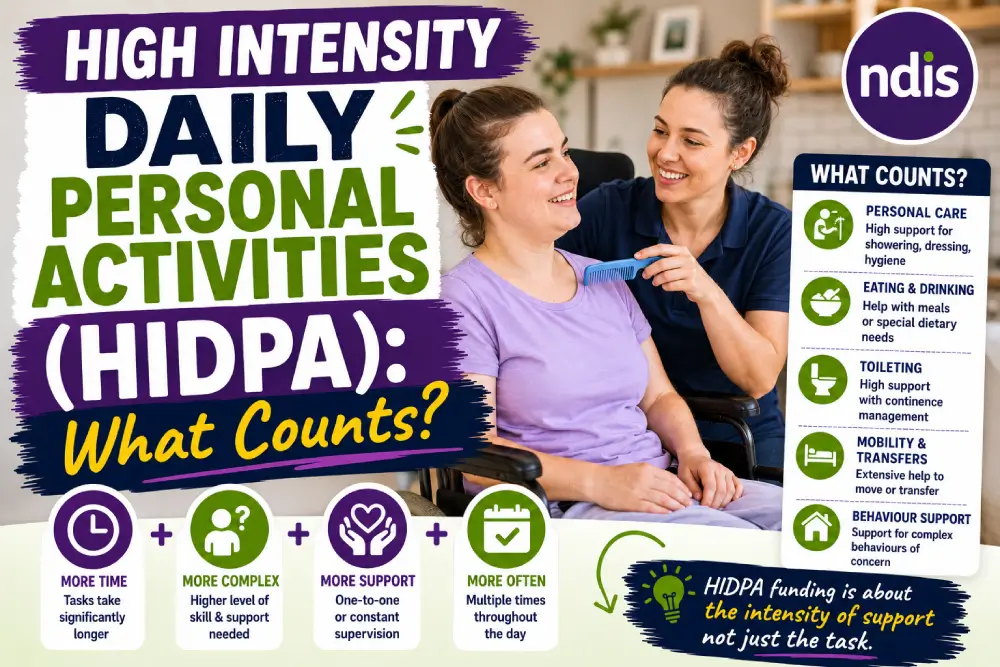
High Intensity Daily Personal Activities — usually shortened to HIDPA — is the funding category for personal care that requires more than standard training. Getting it right matters because workers without HIDPA training cannot legally perform some of these tasks, and underestimating the funding leads to under-resourced support.
What HIDPA Covers
The NDIS Practice Standards identify specific tasks as ‘high intensity’ because they require additional training beyond standard support work. These typically include:
- Complex bowel care — manual evacuation, digital stimulation, suppositories administered by the worker.
- Enteral feeding (PEG feeding) — preparing, administering, and managing nutrition through a feeding tube.
- Tracheostomy management — suctioning, cleaning, changing inner cannulas where the worker has been trained for the participant’s specific needs.
- Ventilation support — managing ventilators, troubleshooting alarms, providing care to participants who require breathing support.
- Urinary catheter care — intermittent catheterisation, suprapubic catheter management, indwelling catheter changes.
- Subcutaneous injections — where required for the participant’s medical management.
- Complex wound management — dressing changes for pressure injuries or complex wounds.
- Severe dysphagia management — supporting participants at high risk of choking during eating and drinking.
- Two-person assistance — where transfers, repositioning, or other care requires two trained workers for safety.
Why It’s Funded Separately
HIDPA workers need additional training and supervision. The NDIS recognises this through a separate funding line at a higher hourly rate than standard daily personal activities.
In practice, that means a participant with HIDPA needs receives more dollars per hour of support — but only if HIDPA is correctly identified in their plan. Plans that fund standard daily personal activities for participants who actually need HIDPA leave providers unable to deliver the support legally or safely.
How HIDPA Gets Into A Plan
HIDPA needs to be flagged at planning, with evidence. Strong evidence includes:
- Reports from medical specialists describing the participant’s clinical needs
- Hospital discharge summaries identifying ongoing complex care
- Allied health reports (occupational therapy, speech pathology) confirming the support level required
- Existing care plans documenting the specific tasks needed
Where a participant’s needs change mid-plan — for example, after surgery or a hospitalisation — a plan variation can be requested rather than waiting for the next review.
Worker Training Requirements
Workers performing HIDPA tasks need:
- Specific training in the relevant task (PEG feeding training is different from ventilation support training, etc.)
- Competency assessment, often by a registered nurse or allied health practitioner
- Ongoing supervision, particularly when supporting a new participant
- Updates when the participant’s care plan changes
Reputable providers are explicit about which workers have which training. If you have HIDPA needs, ask. The answer should be specific.
HIDPA In Different Settings
- In-home support. HIDPA is delivered like any other personal care, just with workers trained for the specific tasks. Participants stay in their own home.
- SIL. SIL homes can be staffed for participants with HIDPA needs, but only where the rostered workers have the right training. Some SIL providers specialise in higher-needs participants.
- Community participation. HIDPA-trained workers can support community participation outings for participants whose needs continue outside the home — for example, those requiring scheduled feeding, suctioning, or medication during the day.
Common Issues
- HIDPA needs not flagged in plan. Participants who genuinely need HIDPA but whose plan funds standard daily personal activities receive less funding than required, and providers cannot deliver the support legally.
- Workers not trained. Some providers accept HIDPA participants without confirming that workers have the right training. This is unsafe and the participant should escalate to the NDIS Quality and Safeguards Commission if it happens.
- Single-trained worker scheduling. Where only one worker on a roster has HIDPA training, sick days create gaps. Reputable providers train multiple workers per participant.
FAQs
Q1. How do I know if my needs are HIDPA?
Talk to your treating professionals. If your care includes any of the tasks listed above (PEG feeding, ventilation, complex bowel care, etc.), HIDPA is likely the right funding category.
Q2. Can my regular support worker just learn HIDPA tasks on the job?
No. HIDPA tasks require formal training and competency assessment, often by a registered nurse. On-the-job familiarity is not enough — there are clinical and legal reasons for this.
Q3. Is HIDPA the same as nursing?
No. Some tasks that look medical are HIDPA-funded support work; some require a registered nurse. The line varies by task and by jurisdiction. Your treating clinician should advise which applies.
Q4. How is HIDPA priced?
Higher hourly rate than standard daily personal activities, set by the NDIS Pricing Arrangements. The exact rate is reviewed annually.
Q5. Can HIDPA be delivered overnight?
Yes. Active overnight HIDPA — worker awake all night, providing scheduled care — is funded for participants whose needs require it.