Every NDIS plan can be managed in three ways: NDIA-managed, plan-managed, or self-managed. The choice affects which providers you can use, how flexible your funding is, and how much administrative work falls on you. Most participants do not realise they have a real choice here — and changing the management type is one of the simplest ways to improve a plan that is not quite working.
NDIA-Managed
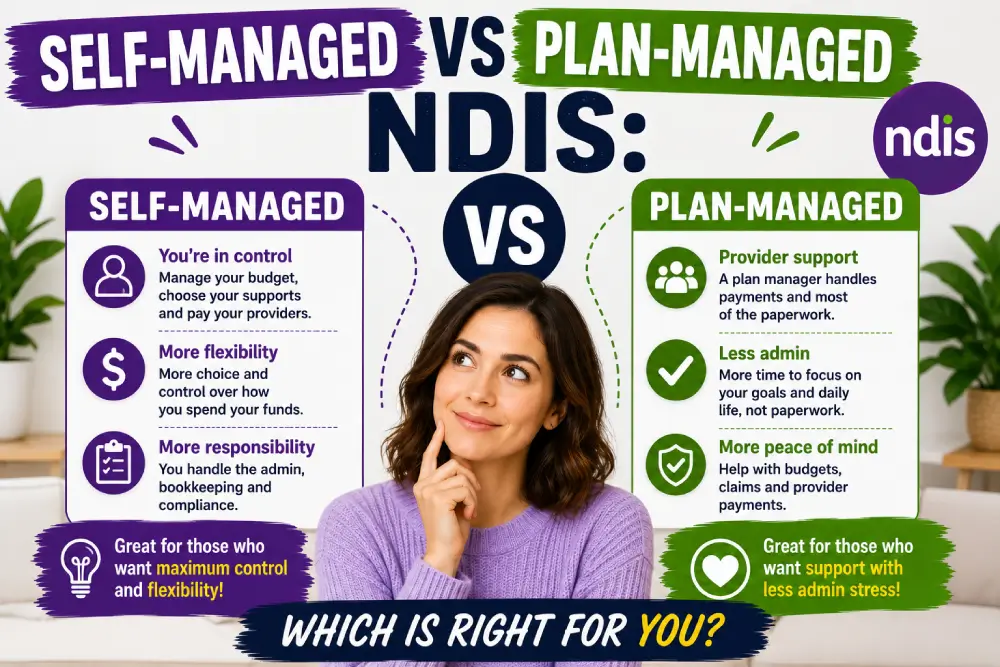
The NDIA pays providers directly. The participant does not see invoices or handle any administrative work.
- Pros: simplest option, no admin, no risk of overspending.
- Cons: must use NDIS-registered providers only. Smaller pool of providers — many specialist therapists, allied health professionals, and smaller community-based providers are not registered. Less flexibility on rates.
NDIA-managed works for participants who want simplicity and have no specific provider preferences. It is the default for many first plans.
Plan-Managed
An external Plan Manager (a registered NDIS provider that handles plan management) receives invoices, pays providers, keeps records, and reports back to the participant and the NDIA.
- Pros: broadest provider choice — both registered and non-registered providers can be used. No admin for the participant. Plan Manager funding is in addition to your other supports, so you do not pay for it out of your own pocket.
- Cons: you depend on the Plan Manager being responsive. Some are excellent; others are slow. Choosing a reliable Plan Manager matters.
Plan-managed is the most popular option in Queensland because it offers maximum choice with minimum admin.
Self-Managed
You receive funding into a nominated bank account, pay providers directly, keep all the receipts, and report to the NDIA.
- Pros: maximum flexibility. Can negotiate rates with providers, hire informal supports (with rules), and customise arrangements that registered providers cannot offer.
- Cons: significant administrative work. You are responsible for keeping records, ensuring all spending is reasonable and necessary, and being audit-ready. Errors can lead to clawbacks.
Self-managed suits participants (or families) with the time, organisational skill, and confidence to take on the admin. It is genuinely empowering for the right person and a burden for the wrong one.
How To Choose
Three questions cut through the choice:
- How important is provider choice? If you want a specific non-registered therapist, you need plan-managed or self-managed.
- How much admin can you handle? Self-managed needs reliable record-keeping. Plan-managed and NDIA-managed do not.
- Do you want to negotiate rates or use unusual arrangements? Self-managed gives flexibility that the other two do not.
Mixing Management Types
You can mix management types within a single plan. For example, NDIA-managed for Core Supports (so you do not have to handle the admin for routine personal care) and self-managed for Capacity Building (so you can pick a specific therapist). Plan reviews are a good time to consider whether this would suit you better.
How to Change Management Type
Request a change at your next plan review, or request a plan variation if there is a clear reason for an early change. The NDIA usually approves changes from NDIA-managed to plan-managed without much resistance. Self-managed requires more discussion because the NDIA needs to be confident the participant or family can handle the admin.
FAQs
Q1. Does plan management cost extra?
No additional cost to the participant. Plan management funding is added to your plan separately and does not eat into your other supports.
Q2. Can I be self-managed and still use registered providers?
Yes. Self-management lets you use any provider — registered or non-registered. The choice is yours.
Q3. What if I want to switch from NDIA-managed to plan-managed mid-plan?
You can request a plan variation. The NDIA will usually agree if there is a clear reason — for example, wanting access to a non-registered allied health professional.
Q4. Are non-registered providers safe to use?
Many are excellent. Registration is a quality and accountability standard, but plenty of high-quality providers operate as non-registered, particularly individual therapists, sole traders, and smaller community-based services.
Q5. Can a Plan Manager refuse to pay an invoice?
Yes, if the invoice is for something outside your plan, exceeds the NDIS Pricing Arrangements, or has other compliance issues. Good Plan Managers explain why before refusing.