Every NDIS plan splits funding into categories. The two participants ask about most are Core Supports and Capacity Building. Understanding the difference is not academic — it directly affects what you can spend money on, who can deliver it, and how flexible your plan really is.
The Core Idea
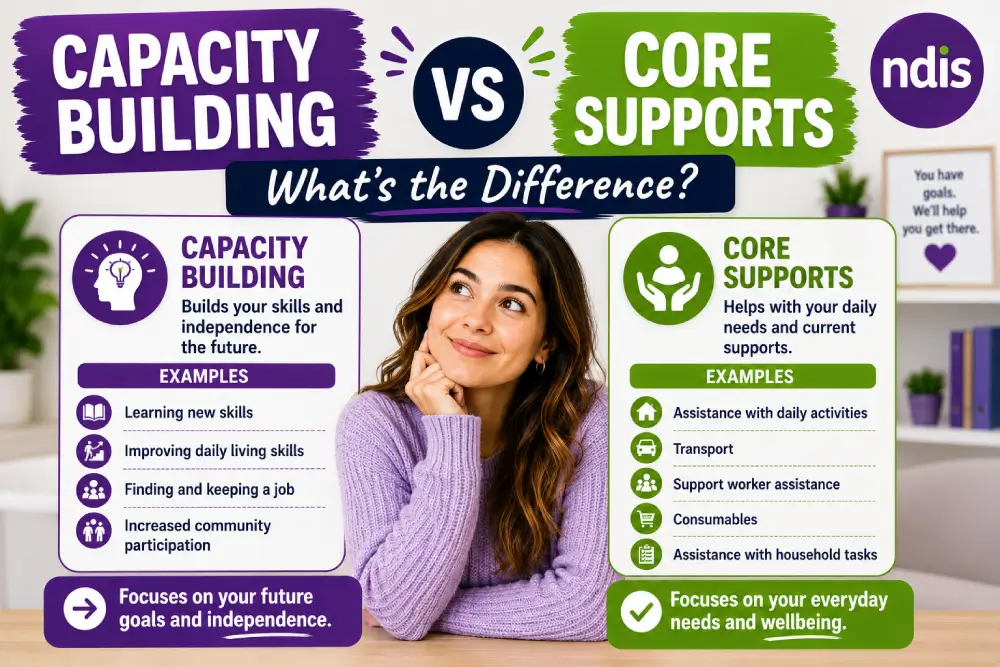
Core Supports pays for the support you receive today. Capacity Building pays for building the skills you want to use tomorrow. Most participants have both, with the balance shifting toward independence as skills grow.
Core Supports — What’s In It
Core Supports has four sub-categories
- Assistance with Daily Life — personal care, household tasks, SIL. The biggest category for most participants.
- Assistance with Social, Community and Civic Participation — community participation, group activities, outings.
- Consumables — low-cost disability-related items like continence products, low-tech assistive devices, nutritional supplements (where prescribed).
- Transport — the Transport Allowance funded for participants who cannot use public transport unaided.
Most Core Supports funding is flexible — you can move money between sub-categories within Core Supports without needing NDIA approval. That flexibility is one of Core Supports’ main strengths.
Capacity Building — What’s In It
Capacity Building has nine sub-categories. The most commonly used are:
- Support Coordination — the funding for support coordinators.
- Improved Daily Living — skill-building work toward more independent living. Cooking, budgeting, transport, communication.
- Improved Health and Wellbeing — exercise physiology, dietetics, health-related allied health.
- Improved Relationships — behaviour support, counselling related to relationships and behaviour.
- Improved Learning — tutoring or coaching for participants in education.
- Improved Life Choices — plan management funding (where the plan is plan-managed).
- Improved Living Arrangements — help finding and securing housing.
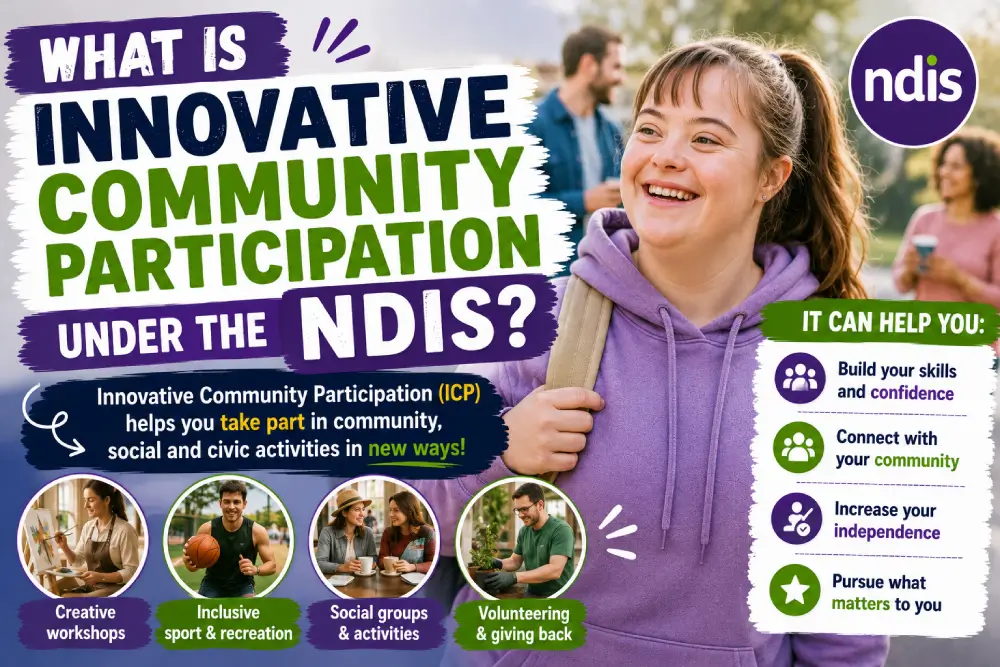
- Increased Social and Community Participation — innovative community participation, structured group programs.
- Finding and Keeping a Job — School Leaver Employment Supports (SLES), employment-related supports.
Unlike Core, Capacity Building funding is generally NOT flexible across categories. If you have funding for Improved Daily Living, you cannot move it to Support Coordination without NDIA approval.
How To Think About The Two
Most participants think of Core Supports as ‘what I get help with day-to-day’ and Capacity Building as ‘how I get better at things over time’. That is roughly right, but the strategic point is that Capacity Building should reduce the need for Core Supports over time, not just sit alongside it.
A participant doing Improved Daily Living work to become more independent in cooking should — in principle — need fewer Household Tasks hours over time. Plans that just keep increasing both year over year often signal that the Capacity Building work is not being effective, or that the participant’s needs have grown faster than the skills.
Common Mistakes
- Treating Capacity Building like more Core. Some participants and providers treat Improved Daily Living as ‘extra household tasks’. The funding is meant for genuine skill-building, not as a top-up of routine support.
- Letting Capacity Building lapse. Capacity Building funding does not roll over between plans. Funding that does not get used does not come back at review.
- Not asking for Capacity Building when it is needed. Many participants have Core funding without enough Capacity Building. If you are working toward specific goals — independence, employment, social skills — Capacity Building is where the strategic work happens.
FAQs
Q1. Can I move Capacity Building funding to Core?
Usually no, without NDIA approval. Capacity Building sub-categories are generally fixed.
Q2. Can I move Core funding between sub-categories?
Yes, mostly. Core Supports are generally flexible — you can use household tasks funding for community participation, for example.
Q3. Is Support Coordination Capacity Building?
Yes. Support Coordination is funded under Capacity Building, separate from your direct support funding.
Q4. What happens to unused Capacity Building funding at the end of a plan?
It does not roll over. Unused Capacity Building funding does not transfer to the next plan.
Q5. Is therapy Capacity Building?
Most allied health therapies are funded under Capacity Building (Improved Daily Living, Improved Health and Wellbeing, Improved Relationships, depending on the therapy and the goal).