
Supported Independent Living is one of the most expensive NDIS support categories — and one of the most opaque. Participants and families often agree to a SIL placement without fully understanding what is being paid for, who is paying for what, and how the funding stretches. This is the actual structure.
What SIL Funds
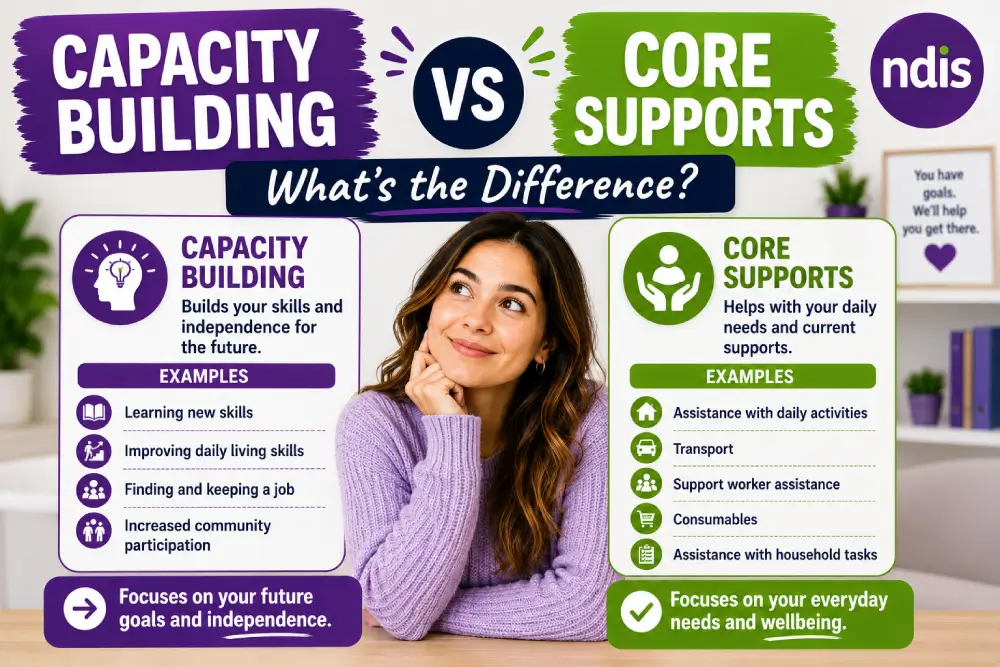
SIL is funded under Core Supports as ‘Assistance with Daily Life — Shared Living Arrangements’. It pays for the support workers in the home — the people delivering personal care, household tasks, medication management, behaviour support implementation, and overnight assistance.
It does NOT pay for:
- Rent or mortgage on the home
- Utilities (electricity, water, gas, internet)
- Food and groceries
- Furniture or household items beyond what the provider supplies
- The participant’s own personal expenses
- Modifications to the home (those are SDA or Capital Supports)
Those costs come from the participant’s own income — usually the Disability Support Pension and Commonwealth Rent Assistance.
The Three SIL Levels
- Lower Needs — for participants who need some assistance but are mostly independent. Worker present during waking hours but able to step away for short periods. Sleepover overnight.
- Standard Needs — the most common level. Worker continuously present during waking hours, providing regular support. Sleepover overnight.
- Higher Needs — for participants who need active intervention throughout the day, two-person assistance for some tasks, and active overnight support (worker awake all night, not sleeping).
The level is set during planning based on a SIL Assessment, usually informed by allied health reports. Higher levels cost more, so the NDIA looks for clear evidence the support level is actually needed.
How Roster Hours Connect To Funding
SIL homes are usually rostered with one worker per shift, sometimes more. Funding pays for those rostered hours. In a 4-bed shared SIL home, the cost of one worker is split four ways — each participant’s plan funds a quarter of the total worker cost.
This sharing is what makes SIL viable. Individual SIL — one participant living alone with funded workers — is much more expensive per hour because the worker cost is not shared.
Sleepover vs Active Overnight
- Sleepover. Worker is on-site, sleeping, available if a participant wakes and needs help. Funded at a lower rate because the worker is not actively providing support all night.
- Active overnight. Worker is awake throughout the night, actively monitoring or supporting. Funded at the standard hourly rate because the worker is fully engaged.
Most participants have sleepover unless their needs require active overnight. The distinction matters because Higher Needs SIL with active overnight costs significantly more than Standard Needs with sleepover.
Common Misunderstandings
- Thinking SIL covers rent. It does not. The participant pays rent from their pension. SIL pays only the support workers.
- Thinking SIL is the same as SDA. SIL pays for support; SDA pays for purpose-built housing. Most SIL participants live in standard rental housing, not SDA.
- Thinking funding rolls over. If a SIL home is under-staffed against its funded level (more support than the participant needed in a given week), the unused funding does not roll over to next week or to the next plan.
- Underestimating shared cost mechanics. Moving from a 4-person SIL to a 3-person SIL changes the per-participant cost of every shift. SIL housemate changes can affect funding more than people expect.
Plan Reviews For SIL
SIL is reviewed at every plan review along with the rest of the plan. Reviews look at whether the funded level still matches the participant’s needs. If the participant has built capacity and needs less support, the level may step down. If support needs have grown, the level may increase.
Reviews also assess the home itself. Whether the participant is still well-matched to the housemates, whether the worker team is delivering, and whether the participant’s goals are being supported.
FAQs
Q1. What does the participant pay for in a SIL home?
Rent, utilities, food, and personal expenses. Typically funded from the Disability Support Pension and Commonwealth Rent Assistance.
Q2. Can I leave a SIL home if it is not working?
Yes. SIL is the participant’s home, not a contract. Reasonable notice applies but no participant is locked in.
Q3. How is SIL different from in-home support?
In-home support is funded under standard Core Supports for participants living independently. SIL is for participants in shared or specialised living arrangements with continuous staffing.
Q4. Can I move to a different SIL provider without leaving my home?
Sometimes — if the home is rented in your name and you can engage a different provider to staff it. Where the home is rented or owned by the provider, changing provider usually means changing home.
Q5. Are SIL costs the same across providers?
Roughly yes. SIL rates are set by NDIS Pricing Arrangements. Quality differences sit in worker continuity, training, matching, and culture rather than hourly rates.