
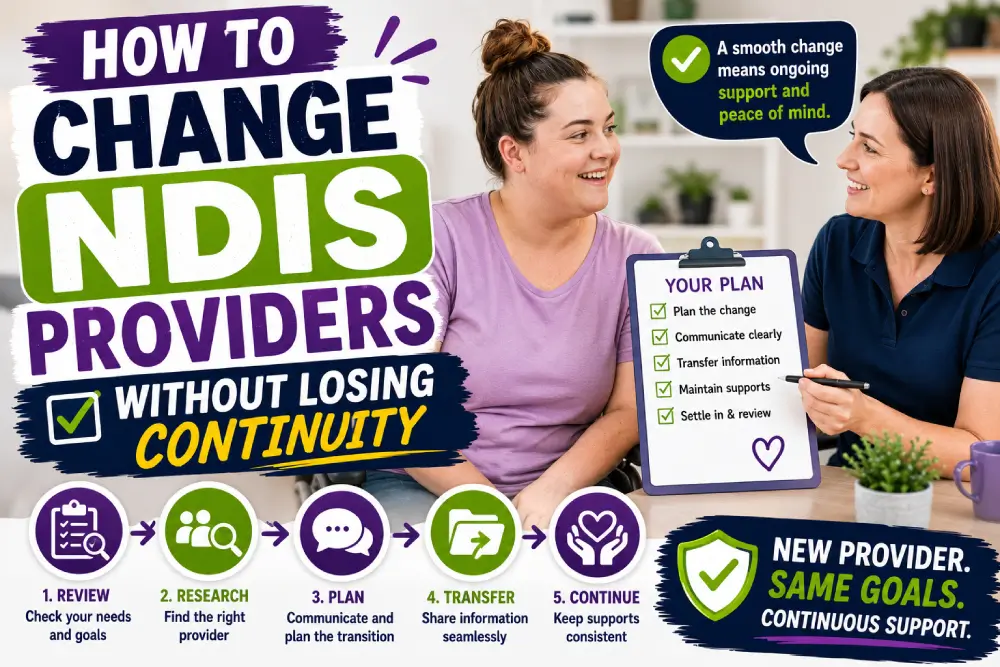
Switching NDIS providers is more common than people think — and more straightforward than people fear. The horror stories about switching usually come from poor handovers, not from any rule that prevents you from changing. Here is how to do it cleanly.
You Are Allowed To Switch
There is no rule limiting how often a participant can change provider. The Service Agreement is a contract, but it is not a lock-in. Notice periods (typically two weeks) are normal. Beyond that, the only thing tying you to a provider is whatever continuity you have built — which matters and which the change process should protect.
When Switching Makes Sense
- Repeated unreliability — workers not arriving, last-minute cancellations, missed shifts
- High worker turnover — new face every week
- Poor communication — calls and emails ignored, slow responses
- Billing issues — invoices that do not match the service delivered, charges for shifts that did not happen
- Workers untrained for your needs — particularly for High Intensity Daily Personal Activities or behaviour support
- Move to a new suburb where the current provider does not have local workers
- A serious safeguarding incident the provider does not address adequately
When Switching May Not Help
- Issues with a specific worker — a swap may be enough; you do not need to change provider
- Funding shortfalls — switching does not fix inadequate funding, that is a plan review issue
- Disagreements about scope — if the issue is what is in your plan vs what you want, the fix is plan review, not provider change
Step-by-Step: How To Switch
- Identify a new provider. Talk to your support coordinator (if you have one), check provider directories, ask other participants. Confirm the new provider has capacity in your area and can deliver the services you need.
- Have the conversation with the new provider before doing anything else. Make sure they can match you with workers, set up a Service Agreement, and start within a reasonable timeframe.
- Read your current Service Agreement to find the notice period. Most are two weeks; some are longer. Plan the transition around that timeline.
- Notify your current provider in writing. Email is fine. State the date you are ending services, thank them where appropriate, and request a handover meeting if useful.
- Request your records. Care notes, medication records, behaviour support implementation logs — these belong to the participant and a good outgoing provider will hand them over without complaint.
- Brief the new provider properly. Share your routine, preferences, equipment needs, and anything that took the previous provider a while to learn. The goal is for the new provider to start ahead of where the old one was after their first month.
- Plan for overlap if possible. A few days of overlap — the new provider shadowing or starting alongside the outgoing one — makes the transition smoother. Funding usually allows this without issue.
What A Good Outgoing Provider Does
Reasonable providers handle handovers professionally even when they would rather keep the participant. The signs of a good handover from the outgoing side:
- Care notes provided promptly
- Final invoices issued on time and accurately
- No retaliation or pressure to stay
- Handover meeting offered, including with the new provider if helpful
- Clear end-date with no surprise charges after
What A Good Incoming Provider Does
- Asks for a meeting before the first shift
- Reads the records the participant provides
- Matches workers based on the participant’s needs and preferences
- Sets a check-in for the first few weeks to catch anything that needs adjusting
- Does not over-promise — they will be honest about what they can deliver
Common Mistakes
- Switching without a confirmed new provider. Notify your old provider only after you have a Service Agreement signed with the new one. Otherwise you risk a gap in support.
- Burning bridges. Even a difficult provider has records and workers you may need information from. Civil exits make for cleaner handovers.
- Not telling your support coordinator. Coordinators often coordinate handovers between providers. Keep them informed even if the change feels straightforward.
- Switching too often. If you have switched providers three times in 18 months, the pattern is worth examining. Sometimes the issue is the providers; sometimes it is something else, like funding or expectations.
FAQs
Q1. Can I switch providers mid-plan?
Yes. There is no rule preventing it. Notice periods apply but no lock-in.
Q2. Will I lose any funding when I switch?
No. Funding belongs to your plan, not the provider. Switching just changes who delivers the service, not what is funded.
Q3. Can my old provider refuse to release my records?
Records belong to the participant. Reputable providers hand them over on request. If a provider refuses, raise it with the NDIS Quality and Safeguards Commission.
Q4. Can I keep some services with my old provider and start others with a new one?
Yes. Many participants use multiple providers. There is no requirement to bundle.
Q5. What if I want to leave a SIL provider?
More involved than other services because SIL is your home. Leaving SIL usually involves a planned transition over weeks rather than days. The participant has the right to leave; the timeline just needs more planning.