When To Complain
Complaints are appropriate when something has gone wrong and either has not been addressed or cannot be resolved internally. Common issues that warrant complaints:
- Unreliable service delivery — repeated missed shifts, last-minute cancellations
- Poor quality care — workers untrained for the participant’s needs, unsafe practice
- Billing issues — invoices for services not delivered, charges outside the Service Agreement
- Communication failures — calls and emails ignored, no response to issues raised
- Worker conduct — unprofessional behaviour, disrespect, breach of privacy
- Safeguarding incidents — abuse, neglect, exploitation, or significant harm
Not every dissatisfaction is a complaint. A worker not being a great match is a request for change, not a complaint. A serious safeguarding incident is always a complaint.
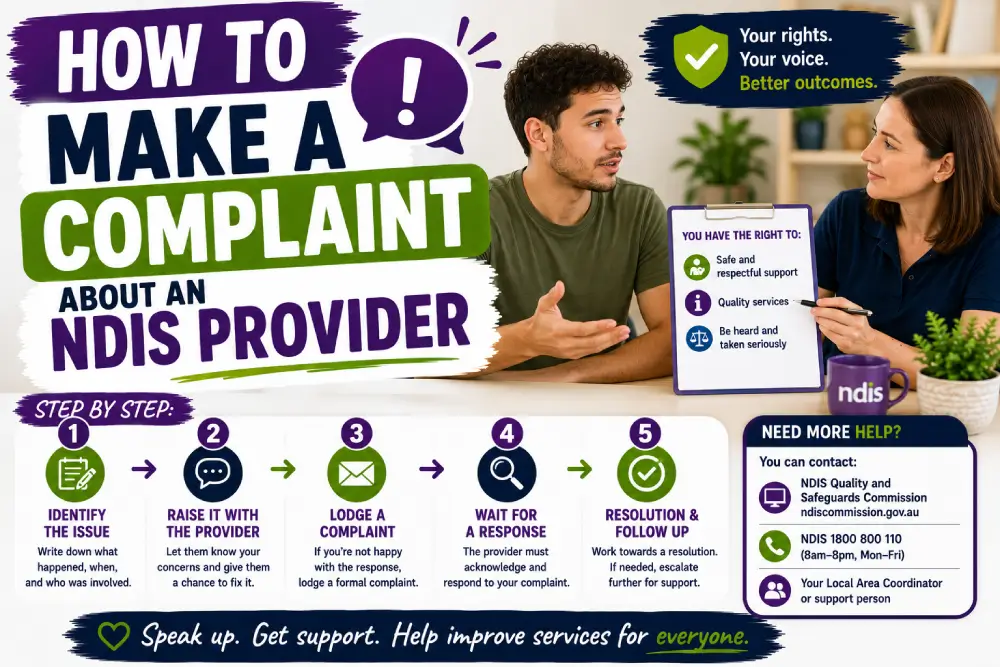
Step 1: Internal Complaint
Talk to the provider first, unless the matter is too serious to do so safely. Most reputable providers have an internal complaints process — they should explain it on request.
A good internal complaint:
- Is in writing where possible (email creates a record)
- States the specific issue with dates, times, and people involved
- Says what outcome you are looking for
- Asks for a written response within a reasonable timeframe (usually 14 to 28 days)
Many issues are resolved at this stage. The provider investigates, addresses the issue, and the participant is satisfied. If not, the next step is external.
Step 2: External Complaint
The NDIS Quality and Safeguards Commission is the federal body that regulates NDIS providers. It handles complaints about provider conduct, service quality, and safeguarding incidents.
Contact the Commission:
- Phone: 1800 035 544
- Online: ndiscommission.gov.au
- Email through the Commission’s website
Anyone can make a complaint — the participant, a family member, a guardian, an advocate, a worker, or a member of the public. Complaints can be made anonymously, though anonymous complaints are harder to investigate.
What The Commission Does
The Commission investigates complaints in proportion to seriousness. For lower-level issues, they may liaise with the provider and resolve through dialogue. For more serious issues, they conduct formal investigations that can result in:
- Compliance notices requiring the provider to fix specific issues
- Conditions on the provider’s registration
- Suspension or cancellation of registration in serious cases
- Referrals to police or other regulators where criminal conduct is alleged
Most complaints are resolved through dialogue and corrective action rather than registration sanctions.
Reportable Incidents
Some incidents are ‘reportable incidents’ that providers must report to the Commission within 24 hours, regardless of whether anyone has complained. These include:
- Death of a participant
- Serious injury
- Abuse or neglect of a participant
- Unlawful sexual or physical contact
- Use of restrictive practice not authorised in a behaviour support plan
Participants and families can also report these incidents directly if they suspect the provider has not done so.
Complaints About Plans, Not Providers
If your complaint is about your NDIS plan rather than a provider — funding amount, plan content, planning decisions — that goes to the NDIA, not the Commission.
- Internal review with the NDIA: request within 90 days of the decision
- External review at the Administrative Appeals Tribunal (AAT) if internal review does not resolve it
After You Complain
Reasonable providers do not retaliate against participants who complain. Retaliation — withdrawing service, increasing prices, reducing quality — is itself a serious issue and can be reported separately.
If your complaint leads to changes you wanted, the relationship may be salvageable. If not, switching providers is reasonable. Either way, your right to make a complaint is protected and exercising it should not put you at a disadvantage.
FAQs
Q1. Can I complain anonymously?
Yes. The Commission accepts anonymous complaints, though they are harder to investigate fully. Confidential complaints (where the Commission knows who you are but does not tell the provider) are also possible.
Q2. Will the provider know I complained?
Usually yes, because the Commission needs to investigate. You can request that some details remain confidential, but the substance of the complaint will be put to the provider for response.
Q3. How long does a complaint take?
Varies. Lower-level complaints may resolve in weeks; complex investigations can take months. The Commission will keep you informed of progress.
Q4. Can I complain about a worker rather than the whole provider?
Yes. Complaints can be specific to individual workers. The Commission also maintains a Workers Banning Order for individuals found to have committed serious misconduct.
Q5. What if my complaint is about a non-registered provider?
The Commission can still take complaints about non-registered providers, though its enforcement options are more limited. Plan-managed and self-managed participants using non-registered providers can also raise issues with their Plan Manager.