
The NDIS is for participants who first applied before turning 65. What happens at age 65 itself depends on whether the person is already an NDIS participant, and what comes next involves a choice that affects support for years to come.
The Basic Rule
To enter the NDIS, you must be aged under 65 at the time you first apply. People aged 65 and over who have not previously been NDIS participants generally access support through the aged care system instead, primarily through the new Support at Home programme that replaced Home Care Packages and the Commonwealth Home Support Programme in November 2025.
If You Are Already An NDIS Participant
Participants who entered the NDIS before turning 65 can continue receiving NDIS support after turning 65 if they choose. Three options:
- Stay on the NDIS. Continue with NDIS funding for disability-related supports. Most participants who developed their disability earlier in life choose this — the NDIS funding is usually more substantial than aged care equivalents.
- Move to aged care. Transition to the aged care system, which funds aged-related care. Some participants find this simpler administratively but may receive less funding.
- Use both. In some specific situations, participants can access aged care for some supports and NDIS for others, though this is uncommon and complex to coordinate.
Why Most Stay With The NDIS
For participants whose disability is the main reason they need support, the NDIS usually offers:
- Higher funding levels — particularly for participants with high support needs
- More flexible support categories — community participation, capacity building, complex care
- Continuity of providers and workers built up over years
- Better recognition of disability-specific needs (versus general aged care)
Aged care, by contrast, is designed around age-related decline rather than lifelong disability. The supports and rates are calibrated differently.
When Aged Care Might Suit Better
Some participants choose to transition to aged care because:
- Their support needs are now more about age-related changes than disability
- They want simpler administration
- The aged care system’s specific facilities (residential aged care) better match what they want for the next stage
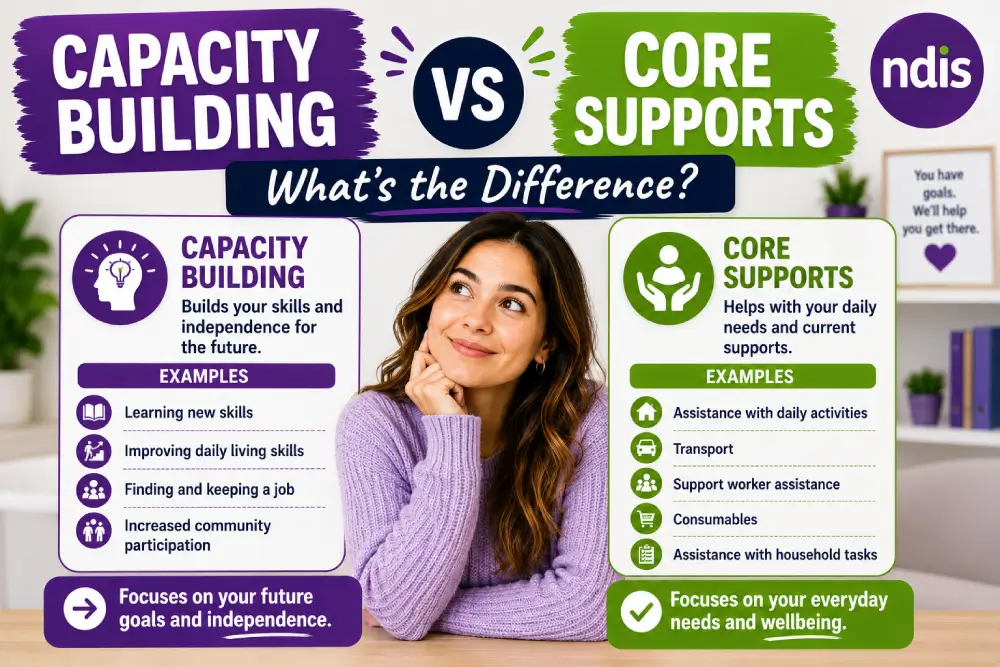
- They have completed Capacity Building goals and the supports they need are now mostly aged-care-style
Planning For The Transition
If you are an NDIS participant approaching 65, the conversation should start at least 6 to 12 months before. Things to think about:
- Are your current supports primarily disability-related or age-related?
- How does the funding compare? An aged care assessment can give a rough indication of what you would receive.
- What about your current providers — can they keep delivering through aged care funding, or only through NDIS?
- What would happen to your support coordination, behaviour support, and Capacity Building work?
The NDIA does not push participants to leave at 65. The decision is the participant’s. Defaulting to staying on the NDIS is reasonable unless aged care is clearly better.
If You Have New Disability After 65
People who develop a disability after turning 65 are not eligible for the NDIS. They access support through the aged care system, which has its own assessment process (My Aged Care, then a comprehensive assessment) and funding structure.
This is one of the structural gaps in Australia’s disability support system — people who acquire disability after 65 receive less funded support than those whose disability is recognised earlier in life. Advocacy organisations work on this issue, but the rules have not changed.
Practical Steps
If you are approaching 65 as an NDIS participant:
- Talk to your support coordinator (or LAC) about the transition options. They should know your situation well enough to advise.
- Consider asking for an aged care assessment for comparison purposes — it does not commit you to anything but gives concrete numbers.
- Talk to your current providers about whether they deliver through aged care funding as well as NDIS. Some do; some do not.
- Make the decision well before your next plan review so it can be reflected in planning.
FAQs
Q1. Can I stay on the NDIS if I turn 65?
Yes, if you were already a participant before 65. The choice between continuing on NDIS and transitioning to aged care is yours.
Q2. What if I am 65 and not yet an NDIS participant?
The NDIS is not available to new applicants over 65. Aged care is the alternative, accessed through My Aged Care.
Q3. Will my providers change if I move to aged care?
Possibly. Some NDIS providers are also registered for aged care; many are not. If your provider does not offer aged care, you would need to find new ones.
Q4. Is aged care less generous than the NDIS?
Generally yes for participants with significant disability. Aged care is calibrated around aged-related needs, not lifelong disability with high support requirements.
Q5. Can I change my mind after transitioning?
Returning to the NDIS after leaving is generally not possible. The decision is significant — get advice from an independent source before making it.