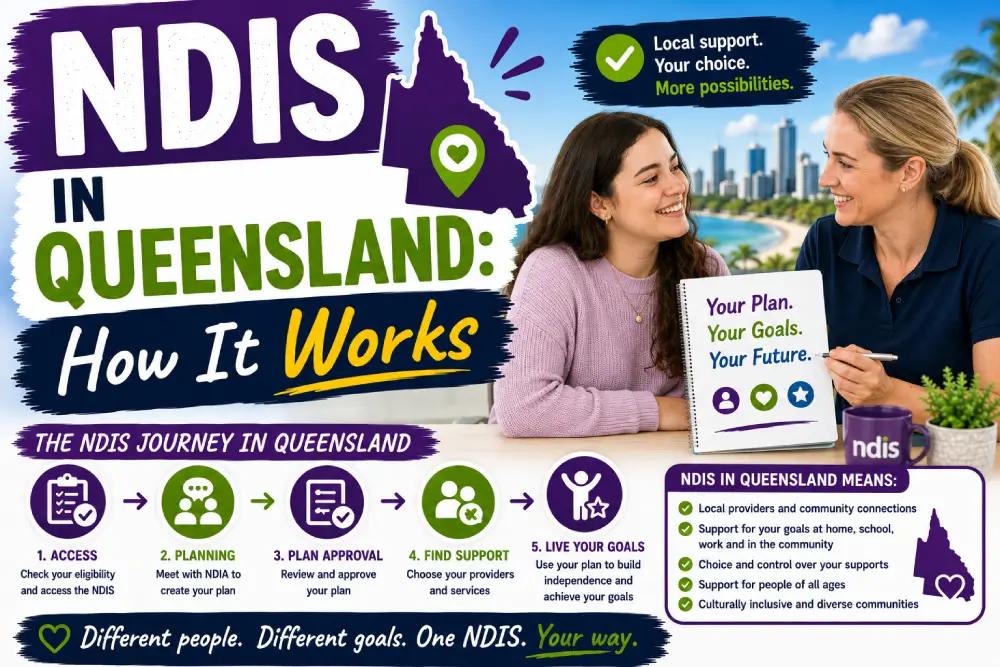
The NDIS is a federal scheme, but how it works on the ground varies by state. Queensland has its own particular set-up — different partner organisations, regional NDIA office locations, and a transition history that affects how the system operates today. Here is what is specific to NDIS delivery in QLD.
How Queensland Was Rolled Out
Queensland transitioned to the NDIS between 2016 and 2019. Different regions came online at different times, with the South East rolling out first and regional and remote areas following. By 2020, every Queensland region was covered.
The transition replaced a patchwork of state-based disability services run through Queensland Health and the Department of Communities. Some former state-based providers became NDIS providers; others closed. The handover was not always smooth, and some participants experienced gaps during the transition.
Queensland’s NDIS Partner Organisations
The NDIA contracts partner organisations to deliver Local Area Coordination (LAC) and Early Childhood (EC) services. In Queensland:
- Carers Queensland — delivers LAC services across most of South East Queensland and parts of regional QLD.
- Mission Australia — delivers LAC in some regional areas.
- EACH — delivers LAC and Early Childhood services across parts of QLD including the Sunshine Coast and Wide Bay.
Local Area Coordinators (LACs) are the participant’s first point of contact with the NDIS for many participants — they help with access, navigation, and connection to community supports. They are not support coordinators (which are funded separately in plans) but they provide some similar early-stage navigation.
NDIA Offices in Queensland
The NDIA operates regional offices across QLD including:
- Brisbane — central Brisbane office and additional locations across the metro area
- Logan — Logan Central
- Ipswich — Goodna and Ipswich
- Toowoomba — Toowoomba City
- Sunshine Coast, Gold Coast, Cairns, Townsville, Mackay, Rockhampton — regional centres
Most participants do not need to visit an NDIA office in person — most interactions happen by phone, online, or through their LAC.
How Queensland’s Health System Interacts With The NDIS
Some supports that look like they should be NDIS-funded are actually Queensland Health responsibilities — and vice versa. The boundaries can be confusing.
- Queensland Health funds: GP and specialist medical care (through Medicare and the public hospital system), nursing care related to medical conditions, allied health for medical rehabilitation, mental health treatment.
- NDIS funds: disability-related supports — personal care, household tasks, capacity building, allied health for disability-related goals (not medical treatment), assistive technology for disability.
The line is not always clear in practice. Discharge from a Queensland hospital can involve negotiation between the hospital, the NDIS, and the participant about which body funds which ongoing supports.
Queensland-Specific Issues
- Regional access. Outside South East Queensland, provider availability is uneven. Some specialist services exist only in Brisbane and require travel. Telehealth has helped, but in-person specialist support remains a challenge in regional QLD.
- Aboriginal and Torres Strait Islander participants. Cultural fit and culturally safe service delivery are particular issues, especially in regional and remote QLD. Some providers specialise in working with Aboriginal and Torres Strait Islander participants.
- CALD participants. Queensland’s culturally and linguistically diverse communities — particularly in Logan, Brisbane South, and parts of regional QLD — benefit from culturally matched service delivery where it is available.
- Cyclone and flood risk. North Queensland, the Wide Bay, and parts of South East Queensland are subject to extreme weather events. Disability services need contingency planning for these.
How To Find Your Local NDIS Contacts
The NDIS website (ndis.gov.au) has a ‘Find a Provider’ search and a list of LAC partner organisations by region. Calling the NDIA on 1800 800 110 connects you to general support that can refer you to your specific LAC.
FAQs
Q1. Who is my Local Area Coordinator in Queensland?
It depends on your suburb. In most of South East Queensland it is Carers Queensland; in some regional areas it is Mission Australia or EACH. Your NDIS plan or the NDIS website lists who covers your area.
Q2. Are NDIS providers in Queensland different from other states?
Most large NDIS providers operate nationally. Smaller providers tend to be state-specific. The rules and funding are the same across Australia — just the local provider mix differs.
Q3. Can I use a Brisbane provider for support in Toowoomba?
In theory yes, but in practice the worker travel time often makes it impractical. Most participants get better service from local providers with workers in their region.
Q4. Does Queensland Health still fund any disability support?
Some — particularly for participants over 65, those with health-only needs, and participants in certain transitional arrangements. The NDIS replaced most state-based disability funding for eligible participants.
Q5. Where do I go for an NDIS complaint in Queensland?
The NDIS Quality and Safeguards Commission handles complaints about providers nationally. The NDIA handles complaints about plans and access decisions. Both have phone and online intake.