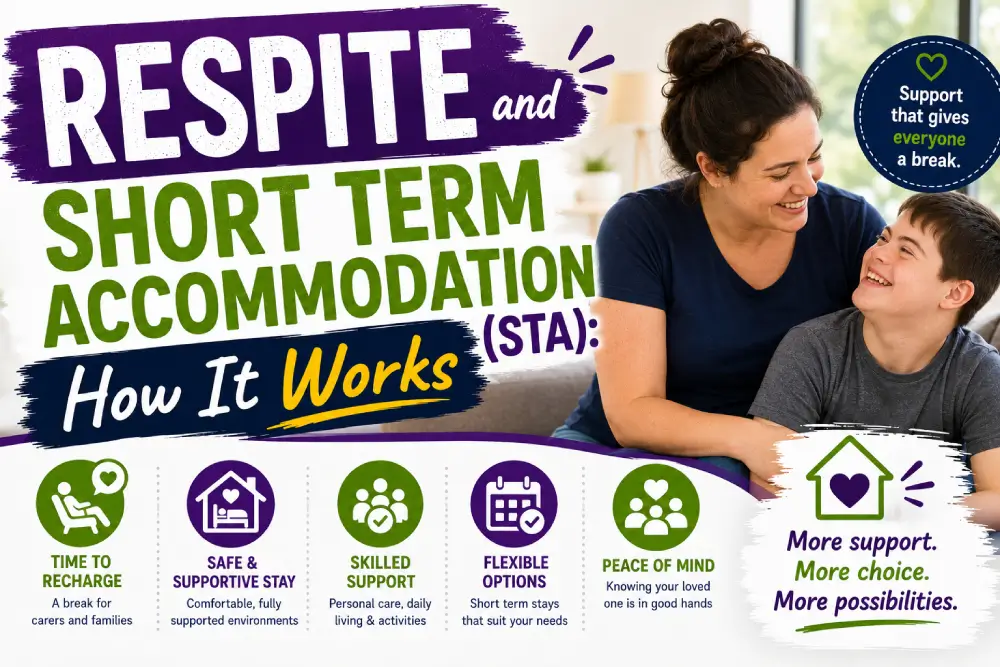
‘Respite’ is the word most people use. The NDIS calls it Short Term Accommodation (STA). The point is the same — short stays away from the usual home environment, giving the participant a different setting and giving family carers a break. Used well, STA prevents bigger problems down the track.
What STA Is
STA is funded under Core Supports as ‘Short Term Accommodation and Assistance’. It pays for short stays — usually between 2 and 14 nights — at a designated accommodation setting where the participant receives full support. The funding covers accommodation, support workers, food, and activities for the duration of the stay.
Unlike SIL, STA is temporary. The participant returns home after the stay. STA exists to give carers a break, manage transitions, or provide trial experiences before bigger decisions like moving into SIL.
What STA Funding Covers
- Accommodation costs at the STA facility
- Support worker time during the stay
- Food and meals
- Activities and outings during the stay
It does not cover the participant’s personal expenses (clothing, personal items, recreational spending) or transport to and from the STA facility.
How Many Nights Can You Have?
Most participants who have STA funded receive 14 to 28 nights per year. Higher allocations are funded for participants whose primary carers need more substantial breaks (for example, where the carer is elderly or where the participant has very high needs).
Stays can be split across the year — multiple short stays — or used in larger blocks if that is what works. Plans usually do not dictate the breakdown; it is up to the participant and family to schedule.
When STA Helps
- Carer breaks. Family carers need rest. STA stays let carers take a holiday, recover from illness, or just have a few days off. Carer burnout is a recurring cause of crisis transitions; preventing it through regular STA is often the better strategy.
- Trialling shared accommodation. Before deciding on SIL, an STA stay in a similar setting gives the participant a real experience. Most SIL providers run STA placements; some specialise in transition stays.
- Routine variation. Some participants benefit from periodic change. STA can be the structured way to provide that without disrupting the home arrangement.
- Recovery from family events. Hospital admissions, family bereavements, household disruptions — STA provides stable accommodation while the home situation settles.
- Activity-based stays. Some STA providers run themed stays — beach trips, sport-focused weekends, structured activity programs. These are particularly useful for participants who would not otherwise access these experiences.
How To Plan A Stay
Most STA stays are booked weeks or months in advance. Things to plan:
- Dates that work for everyone — the participant, the carer, and the STA facility
- What the participant needs taken (medications, equipment, personal items)
- Care plan details — routine, preferences, medical information, behaviour support plans
- Communication with the STA workers — they need a thorough handover before the participant arrives
- Backup contact in case anything happens during the stay
First STA stays are often shorter (2 to 3 nights) so the participant can experience the setting before longer stays are scheduled.
STA vs Other Forms of Respite
- In-home respite. A worker comes to the participant’s home so the family carer can leave for a few hours or a day. Funded under regular Core Supports, not STA. Different funding category, different purpose.
- Centre-based respite. Day programs that run for set hours and provide structured activities. Can give carers regular weekday breaks. Funded under Core Supports as Group Activities.
- STA. Overnight or multi-night stays in a separate accommodation setting. Funded specifically as STA.
- Emergency respite. Where a sudden situation requires immediate respite (carer illness, hospitalisation), some providers can accommodate short-notice STA stays.
Common Mistakes
- Not asking for STA at planning. Many participants do not have STA in their plan because no one asked. If carer breaks would help, request it specifically with evidence of carer load.
- Saving up STA nights. Banking the entire year’s allocation for one big stay sometimes works, but means no shorter breaks across the year. A mix is often more sustainable.
- Not handing over properly. Sending the participant to STA without a thorough briefing of the workers there leads to inadequate support. Take the time to do the handover well.
- Treating STA as ‘somewhere to put the participant’. STA works best when the participant gets something out of it too — new activities, social contact, a break from the home routine.
FAQs
Q1. How is STA different from SIL?
STA is short-term and temporary. SIL is the participant’s permanent home. They are funded under different rules and rates.
Q2. Can I have STA at any provider?
STA is delivered by registered providers with STA capacity. Not all SIL providers offer STA, and some providers specialise specifically in STA.
Q3. Can my support worker accompany me to STA?
Generally no — STA includes its own support workers as part of the funded stay. Some participants with very specific needs may have arrangements where a familiar worker is involved, but this is unusual.
Q4. Can STA be used for holidays?
STA stays can include holiday-style activities, but the funding is for the support and accommodation, not the holiday itself. Travel costs (flights, hotels for an unsupported holiday) are not NDIS-funded.
Q5. What if my STA stay does not go well?
Tell the provider during the stay if you can. Family or carer should be reachable for the duration. If the stay is genuinely failing, ending it early is usually possible. Use the experience to choose a different STA provider next time.