Telehealth went from optional to mainstream in the disability sector during the pandemic. Some uses stuck; others did not. Five years on, the sector has a clearer picture of where telehealth genuinely helps and where it falls short.
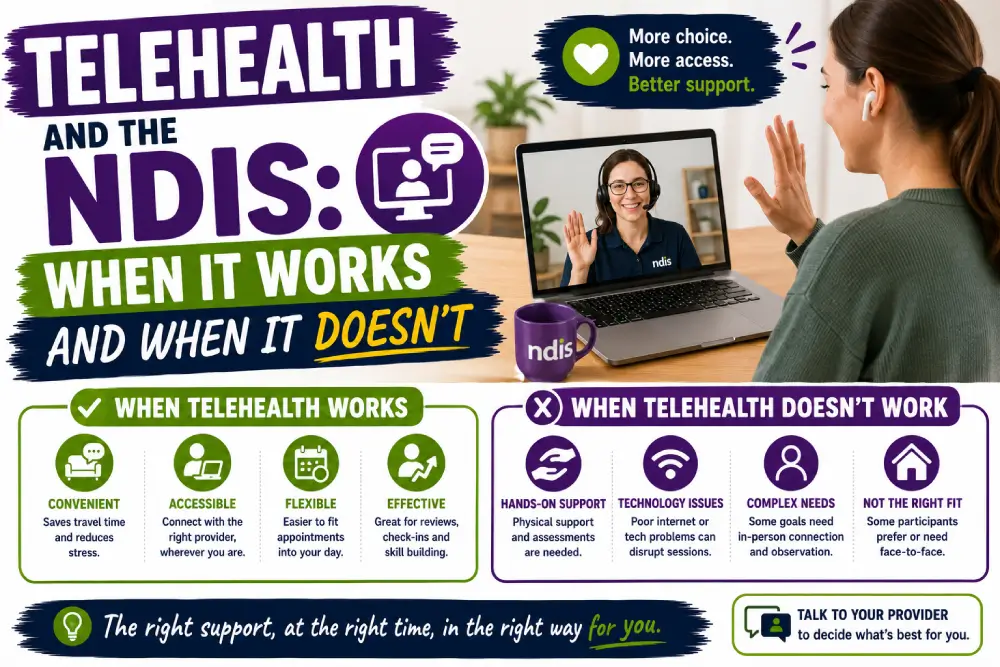
What Works Well Over Telehealth
- Allied health follow-ups. Once an Occupational Therapist or Speech Pathologist has done their initial in-person assessment, regular check-ins, progress reviews, and goal-setting work fine over video.
- Behaviour support consultations. Family meetings, plan reviews, and behaviour support practitioner check-ins translate well to video. The relational aspect comes through over a screen.
- Support coordination. Most coordinator work is talking and document review. Both work over video.
- Therapy review and homework. Reviewing what the participant practised between sessions, planning the next round, troubleshooting — these are all video-friendly.
- Regional access. For Toowoomba and other regional participants, telehealth means access to specialists who do not have a regional office.
What Doesn’t Work Well Over Telehealth
- Initial assessments requiring physical observation. An Occupational Therapist assessing transfer technique, a Physiotherapist assessing mobility, a Speech Pathologist assessing swallowing — these need to be in person.
- Hands-on therapy. Manual therapy techniques, equipment fitting, mobility training — none of this works over video.
- Participants with significant communication needs. Some participants who use AAC devices, have severe autism, or rely on environmental cues find video calls overwhelming or impractical.
- Crisis or safeguarding situations. When something is going wrong, in-person presence is usually needed.
- Most direct support work. Personal care, household tasks, community participation — these are physical-presence services that cannot be delivered over video.
Funding Telehealth Under The NDIS
Telehealth allied health is funded at the same rate as in-person allied health under the NDIS Pricing Arrangements. The participant’s plan does not need to specify telehealth — the format is decided between participant and provider based on what works.
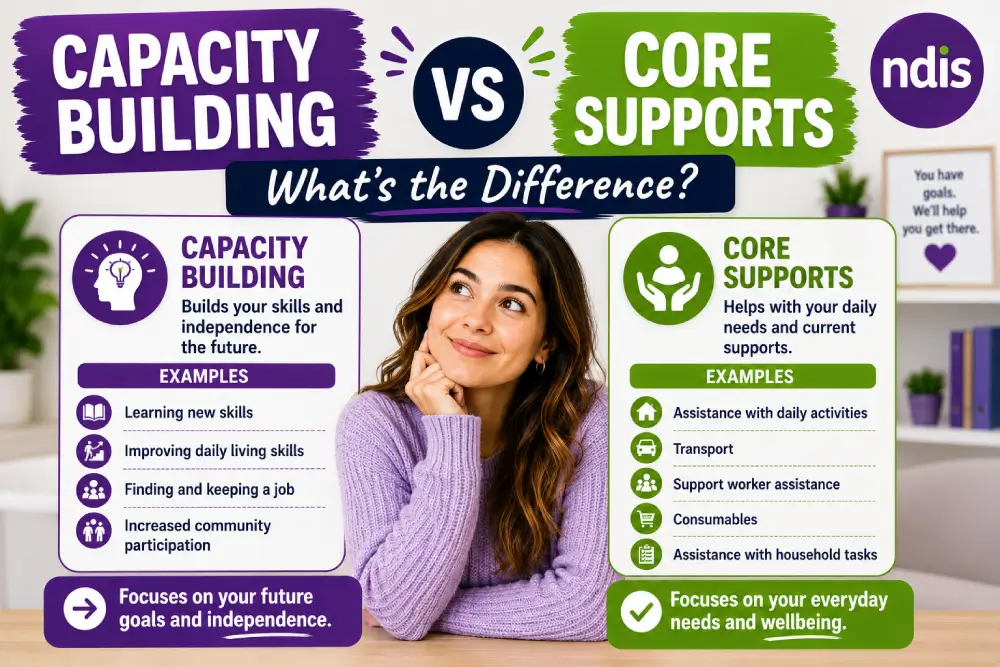
Some Capacity Building work can be partly telehealth and partly in-person. A common pattern: in-person assessment, then a mix of in-person and telehealth sessions, with telehealth for routine review and in-person for hands-on work.
Making Telehealth Sessions Work
- Stable internet matters. If the connection drops, the session is undermined.
- Quiet space matters. Telehealth in a noisy environment is exhausting and ineffective.
- Privacy matters. Sessions about behaviour or personal care should not be conducted where others can overhear.
- Backup plan. Phone is the fallback when video fails. Have the practitioner’s number handy.
- A support person can be present. For participants who benefit from someone alongside them during sessions, telehealth still allows that — they just need to be on the same screen or nearby.
Regional Use Cases
Telehealth is particularly useful for regional and remote QLD participants. A Toowoomba participant can see a Brisbane-based specialist OT for routine reviews without driving down the range. A participant in a smaller Darling Downs town can access a Specialist Support Coordinator who does not have a regional presence.
That said, the in-person component cannot be skipped entirely. Most allied health requires at least an annual in-person review even if most of the year is telehealth.
FAQs
Q1. Is telehealth funded at the same rate as in-person?
Yes. The NDIS Pricing Arrangements use the same hourly rate for telehealth and in-person allied health.
Q2. Does the practitioner need to be in Queensland?
Generally yes for allied health, due to professional registration. Most allied health professionals are registered in specific states. Confirm with your provider.
Q3. Can my support coordinator work entirely over telehealth?
They can, but most coordinators benefit from at least occasional in-person contact for participants whose situation is complex.
Q4. What if I do not have reliable internet?
Phone is a workable fallback for many telehealth services. Some practitioners can travel to community venues with reliable internet. Tell your provider about access constraints early.
Q5. Can group programs run over telehealth?
Sometimes. Skill-building groups (cooking, communication, social skills) generally work better in person. Information-based group programs (like education sessions) can work over video.